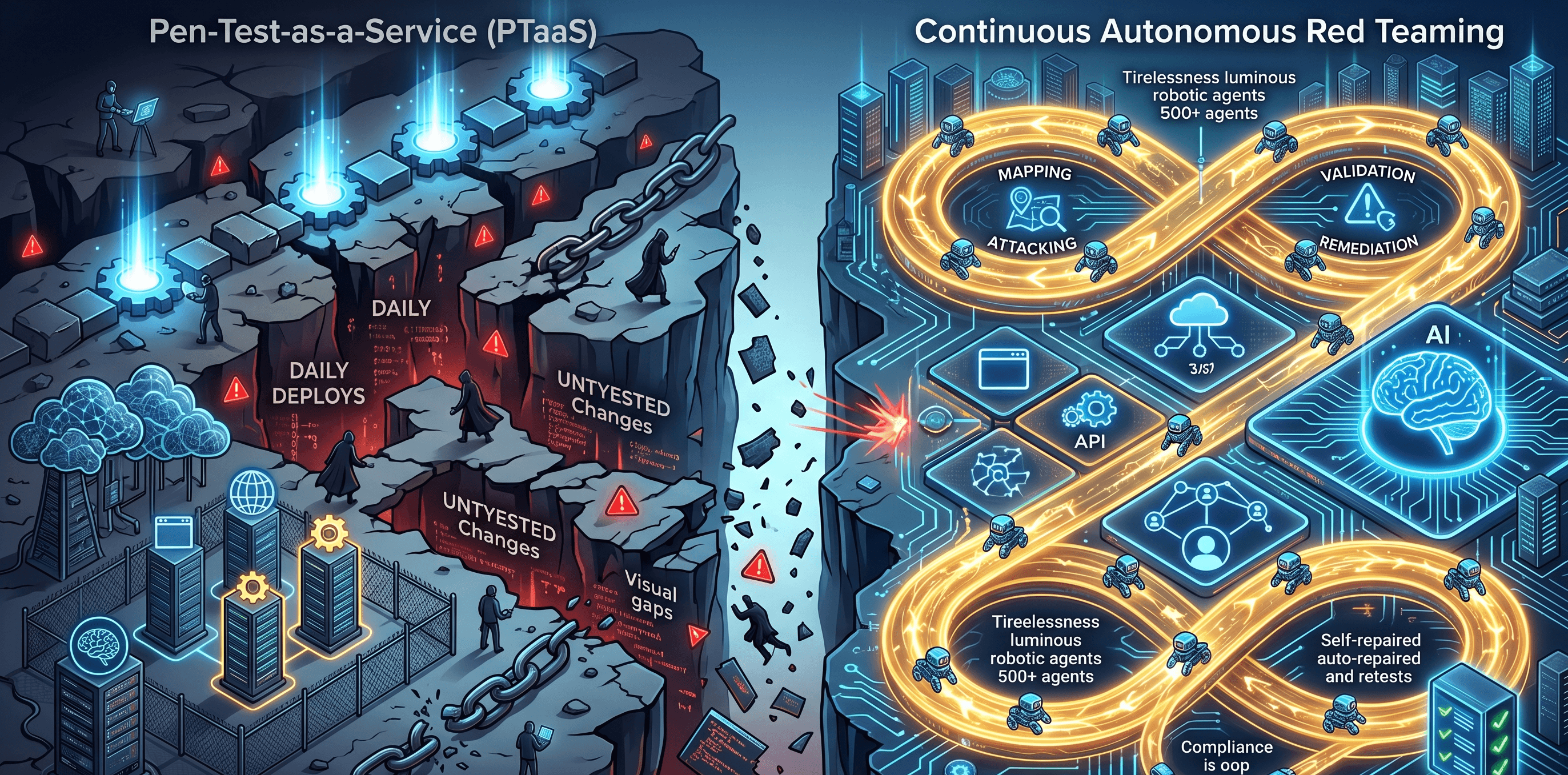
Penetration testing as a service was a real improvement over the old model. Instead of emailing a consultancy, waiting months, and receiving a PDF, PTaaS gave teams a platform, faster scheduling, and a cleaner way to manage findings. Vendors like Cobalt, Synack, Intruder, BreachLock, and Pentera built solid businesses making on-demand penetration testing more accessible than it had ever been.
But the model has a ceiling, and many security teams have hit it. On-demand still means you ask for a test, wait for it, and receive a snapshot. In a world where you ship code every day and your attack surface grows every sprint, a snapshot is outdated almost as soon as it lands. Continuous autonomous red teaming is the next step: always-on validation that tests your full stack the way an adversary would, proves what is exploitable, and follows through on remediation, without waiting for you to book an engagement.
None of these signs is, on its own, a reason to overhaul your program. But if you recognize three or four of them, the pattern is usually the same underlying issue: you are validating a continuous, fast-moving system with a model designed for discrete, scheduled events. Here are nine signs you have outgrown on-demand PTaaS, and how continuous red teaming closes each gap.
1. Your attack surface changes faster than your test schedule
This is the foundational problem. If you test quarterly but deploy daily, then for roughly eighty-nine days out of ninety, your newest changes are untested. Real adversaries do not wait for your next scheduled window; they probe continuously. Any model built around discrete engagements, no matter how fast the scheduling, leaves long stretches of your environment unvalidated.
Continuous red teaming inverts the cadence. Instead of testing on a calendar, it tests on change. The work runs in an always-on loop that maps your environment, attacks it, validates what is exploitable, supports remediation, and retests, then loops back to discovery. Platforms built this way, including SpartanX, treat validation as a continuous process rather than an event, so the thing you shipped this morning can be tested this afternoon.
2. You are waiting in a queue for human testers
The defining constraint of human-led PTaaS is people. Researchers are talented but finite, and demand spikes around release deadlines and audit season. That produces queues. When you need a test most urgently, right before a launch, is often exactly when availability is tightest, and a "fast" on-demand model can still mean days or weeks of waiting.
Automated penetration testing removes the scheduling bottleneck because there is no roster to coordinate. A coordinated system of AI agents can begin immediately and run around the clock. SpartanX, for example, runs more than 500 red teaming agents continuously, so testing starts when you need it rather than when a human becomes available. The result is rapid coverage that does not compete with everyone else's deadlines.
3. Findings arrive as point-in-time snapshots that are stale on delivery
A PTaaS report describes your environment as it was during the testing window. By the time you read it, you have shipped fixes, added features, and changed configurations. You end up remediating a version of your system that no longer exists, while the current version goes untested until the next round.
Continuous red teaming produces a living picture instead of a snapshot. Because it retests automatically after changes, the findings reflect the system as it is now, not as it was weeks ago. That shift, from a historical artifact to a current state of exploitable risk, is one of the clearest reasons teams move beyond on-demand models.
4. You are rationing scope to control cost
On-demand engagements are priced per test, which forces a quiet compromise: you scope down to what the budget allows. The crown-jewel app gets tested; the secondary services, the staging environments, and the forgotten integrations wait for "next time." Attackers, of course, head straight for the things you did not scope.
Continuous platforms change the economics of coverage. Rather than paying per scoped engagement, you get ongoing validation across the whole surface, which removes the incentive to leave assets untested. This is where teams searching for affordable penetration testing for companies should reframe the question: the goal is not the cheapest single test, it is the lowest cost per unit of real, validated coverage over time. Continuous validation across every surface usually wins that comparison, even before you count the breaches it prevents.
5. Coverage stops at the surface you scoped, with no cross-surface chaining
Most PTaaS engagements are organized by surface: a web app test here, a network test there. Real attacks do not respect those boundaries. An adversary chains a low-severity web flaw into a stolen token, uses it to reach a cloud misconfiguration, and pivots into identity. If your testing examines each surface in isolation, the multi-step path that actually leads to compromise never appears in any single report.
This is a structural strength of full-stack autonomous red teaming. SpartanX runs across six attack surfaces at once, web, APIs, networks, cloud, identity, and AI systems, and chains findings across them to prove complete attack paths rather than disconnected issues. Cross-surface chaining is exactly the part of adversary behavior that scoped, single-surface engagements are least equipped to reproduce.
6. You cannot easily tell whether a fix actually worked
In the on-demand model, verifying a remediation often means commissioning another test or waiting for the next cycle. In the meantime you are trusting that the fix landed correctly and did not introduce a new issue. That uncertainty is uncomfortable for any team that has watched a "fixed" vulnerability quietly reopen after a later deployment.
Continuous red teaming builds retesting into the loop. Once a fix ships, the system attempts the exploit again and confirms whether the risk is genuinely closed. Beyond validation, mature platforms move into remediation directly: SpartanX prioritizes findings by real business impact and can generate code fixes and open pull requests, then retest to confirm the fix held. That closes the loop from discovery to proven resolution without a separate engagement.
7. Your AI and LLM features are not being tested at all
This sign is newer and increasingly urgent. Organizations are embedding large language models and AI agents into core products, yet most PTaaS scopes and scanner rule sets barely touch them. Prompt injection, guardrail bypass, model extraction, and agent tool abuse are live risks, and they often sit in the least-tested part of the stack precisely because it is the newest.
Continuous platforms with native AI red teaming treat these systems as first-class targets. SpartanX tests AI systems and agents with the same exploit-validated rigor it applies everywhere else, and demonstrated that depth by completing SecureLayer7's "Son of Anton" challenge end to end, including guardrail bypass, system prompt and secret extraction, and multi-step prompt injection chains. If your products now include AI features, testing that does not cover them is leaving your fastest-growing risk surface unexamined.
8. False positives and unvalidated findings are eating your team's time
Some PTaaS offerings lean on scanning between human engagements, and scanners are noisy. Your team spends hours triaging findings that turn out to be unreachable, unexploitable, or simply wrong. Every false positive is time taken from real work, and over a quarter that adds up to a meaningful tax on a team that is already stretched.
The antidote is exploit validation. When a finding only survives if it was actually exploited and backed by evidence, the noise collapses. SpartanX ships every finding exploit-validated with proof-of-concept evidence, and through its validation of imported scanner findings it can cut up to ninety-five percent of the noise, leaving the short list that genuinely warrants attention. Getting your engineers out of the triage queue is often the most immediate, tangible benefit of the move.
9. Compliance has become a recurring fire drill
When testing is tied to discrete engagements, audit season becomes a scramble to produce a fresh artifact in time. The pen test exists to satisfy the auditor, and the audit is what forces the test, a backward dependency that makes the whole program reactive.
Continuous red teaming turns audit evidence into a byproduct of normal operations. Findings can be mapped to control requirements across SOC 2, PCI-DSS, HIPAA, ISO 27001, NIST, GDPR, and DORA on an ongoing basis, with remediation tracked and verified through retesting. Instead of a once-a-year fire drill, you can show a living record of exploitable risk found, fixed, and confirmed fixed. The compliance story gets stronger because it stops being a separate exercise.
What continuous red teaming does not change
It is worth being clear about what stays the same, because the move to continuous validation is sometimes oversold as a clean break from everything that came before. It is not. You still need a security team with judgment. You still need to decide what matters most, what risk you are willing to accept, and where to focus remediation effort. Continuous red teaming gives that team far better inputs, a current and proven picture of exploitable risk instead of a stale and noisy one, but it does not make the strategic decisions for you. The humans are still in charge of direction.
You also keep control of scope and rules of engagement. A common misconception is that "autonomous" means the system runs wild. In practice you define the boundaries, approve sensitive actions, and direct outcomes, while the agents handle the relentless execution. SpartanX, for example, is explicit that no humans are required to execute the testing, yet you remain in full control through scope definition, action approval, complete visibility, and audit trails. Autonomy applies to the labor, not the authority.
And you do not necessarily abandon human-led testing entirely. There will still be moments, a sensitive acquisition, a novel system, a high-stakes compliance requirement, where you want experienced humans in the loop. The shift is that those engagements become deliberate choices for high-judgment work rather than the entire foundation of your testing program. The continuous platform becomes the baseline that keeps the whole surface honest every day, and human expertise gets pointed at the problems that genuinely reward it.
Is it time to move beyond on-demand PTaaS?
If you recognized your team in several of these signs, you have likely outgrown the on-demand model. None of this means PTaaS was a bad investment. Cobalt, Synack, Intruder, BreachLock, and Pentera each solved a real problem, and human-led testing still has its place for sensitive, judgment-heavy engagements. The point is that on-demand testing was designed for a slower release cycle than the one you are living in now.
For teams specifically looking for a Cobalt alternative or a way past the limits of pentest as a service, the question is not which vendor schedules fastest. It is whether you want testing that happens on a calendar or testing that happens continuously, across your full stack, with every finding proven and every fix verified. Replacing manual penetration testing with a continuous, autonomous model is less about cost per test and more about never going dark between tests again.
The most effective programs keep human experts for the work that genuinely needs human creativity and judgment, and put continuous autonomous red teaming underneath as the always-on baseline that keeps the entire surface honest. That combination, not the next faster engagement, is what closes the gap for good.
A practical way to decide is to score yourself against the nine signs above. If only one or two apply, your current PTaaS may still be a reasonable fit, and the move can wait. If three or more apply, and especially if they include the structural ones, an attack surface that changes faster than your schedule, coverage that stops at scoped surfaces, AI features that go untested, you are carrying risk that the on-demand model is not built to address. The cost of staying is not visible on an invoice; it shows up as the days and weeks your latest changes sit unvalidated, and as the exploitable paths that an adversary has time to find before your next engagement does. Continuous validation removes that silent window, which is ultimately why teams make the move.
To see continuous, exploit-validated red teaming applied to your own environment, book a demo.
Ready to see SpartanX in action?
See how a continuous adversary maps your whole attack surface, inside and out, and proves what is actually exploitable.